
Patch Tuesday October 2025
News categories
Latest posts

Gartner, a firm specialising in research, consulting, and conferences for businesses worldwide, launched in 1995 a product called the Gartner Hype Cycle (GHC). The GHC is a hype cycle framework that conceptualises the birth, evolution, and use of new emerging technologies.
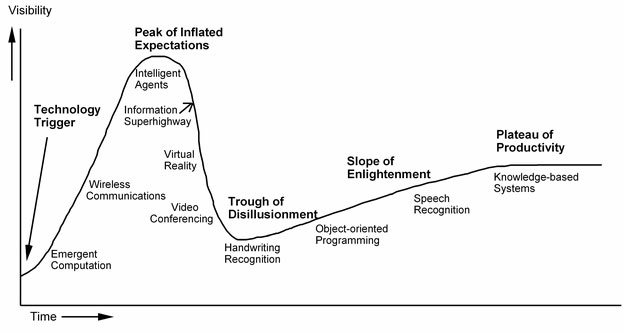
This methodology, comprised of five stages, describes the life cycle of those emerging or innovative technologies:
1-Innovation trigger
A new technology is often discovered, but it is more frequently unproven scientifically or commercially. Articles about it start surfacing. People start talking about it.
2-the peak of inflated expectations
The "re-inventing the wheel" phenomenon intensifies the highlighting of the new technology.
3-the trough of disillusionment
The promised plug-and-play implementation of the new technology has not been delivered.The disillusionment may have originated from technical complexity, unexpected cost or both.
4-the slope of enlightenment
The not-so-new technology undergoes different versions, improvements, or testing. At this stage, the technology is not yet mainstream.
5-the plateau of productivity
The final stage describes the product's maturity, i.e., when it becomes widely accepted by both business users and end-users.
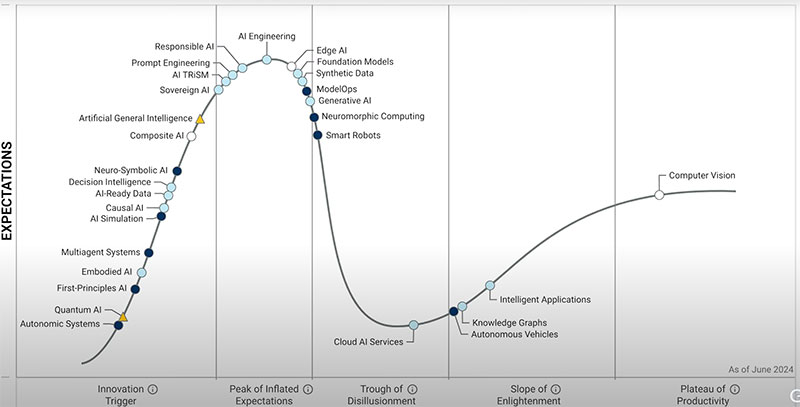
Graphically symbolised by a curve, the GHC started, right after its inception, being utilised in domains other than technology.
Beyond technologies, what was hidden was the human approach or human psyche to novelties, as explained by Jackie Fenn, creator of the Gartner Hype Cycle, in an online article. The interesting aspect of the curve helps distinguish between short-term enthusiasm, or a slight but more dramatic euphoria, and the long-term impact of, say, a new technology. Without mentioning the in-between, the cost or business impact of going from birth to maturity. Suppose the new technology in question can make it out of the inception.
One of the latest examples is artificial intelligence (AI). A little bit of history will help us frame the technology.
It all started with ChatGPT, launched in late 2022, marking the first time AI was used. The trend, before the introduction of ChatGPT, was robotic process automation (RPA). For example, such automated processes were found in Alexa from Amazon or in Microsoft Power Automate. To put it simply, instead of clicking ten times on the same button, a small script or process, even via voice command, can do it for you.

Returning to AI, the first AI processes (stage 4 of the hype cycle) were often glorified RPAs.
Microsoft, one of the main stakeholders in ChatGPT, has incorporated AI into its technologies, targeting two distinct audiences. A larger audience, made more widely accessible through its search engine Bing, and a business audience by harnessing AI (Microsoft Pilot) to its cash cow, the Microsoft Office Suite, launched in March 2023.
The purpose of reaching a larger audience is to hype and refine the process, while the purpose of targeting businesses is to start monetising the idea. Today, a more mature AI has given rise to various products, such as generative AI or Agentic AI, defined as a software system that interacts with data and tools in a way that requires minimal human intervention. Examples of Agentic AI are Joule (SAP agent) and Microsoft Pilot.
If you examine the five stages, stage two is almost another way to describe a bubble. The Gartner Hype Cycle is more of a life cycle than just a hype cycle. Let us stick to the core of the subject dealt with, which is Hype. As explained by Sir Roger Penrose, artificial intelligence bears no resemblance to intelligence, as it lacks consciousness. Even the expression AI is hyped.
Marketing is another type of hype, often associated with promotional efforts and scarcity.
Before the release of the first-person shooter video game Call of Duty: Black Ops 6 in late October 2024, Activision, the publisher, offered early access to the game almost two months before its release. Enticing the potential buyer by offering a not-so-cheap sample of the game is another way to create the hype. Let me rephrase it: to engage with the public or to generate excitement. Before the release of any movie, we have all been captivated by eye-catching teasers or trailers, which are essentially samples of the film's best parts. Creating buzz or drawing attention to potential prospects is one of the foundations of hype, a widely used marketing strategy. Influencers, across video-sharing platforms, play the same role of "let people know," with a significant number of them being sponsored by brands or agencies acting on behalf of the brands.
Often, questionable practices, to say the least, some would use the term 'unethical,' are associated with the necessity of selling a product or service. Over-promising, under-delivering, exaggerating, or misleading are the sorts of marketing traps we all fall into, sometimes repeatedly. Associating these terms with hype is not a false statement.
Hype is emotionally and psychologically loaded.
Sources
https://www.gartner.com/en/research/methodologies/gartner-hype-cycle (Gartner Hype Cycle)
https://www.linkedin.com/pulse/first-hype-cycle-origin-story-jackie-fenn (Jackie Fenn - Author of Gartner Hype cycle)
https://www.forbes.com/councils/forbescommunicationscouncil/2020/12/08/whats-the-hype-all-about-tips-on-creating-brand-hype (Hype in marketing)
https://www.gartner.com/en/documents/5505695 (Hype Cycle for Artificial Intelligence, 2024)
https://www.youtube.com/watch?v=jB1RDz9jaj0&t=3s (Gartner Hype Cycles, Explained)
https://www.youtube.com/watch?v=qXKYOR3KqxQ (It’s Here: The 2024 Gartner AI Hype Cycle™)
https://www.youtube.com/watch?v=e9484gNpFF8 (Sir Roger Penrose)